


A Complete Guide to Commercial Exhaust Hood Types
Choosing the right commercial exhaust hood isn’t just about ventilation. It directly impacts safety, compliance, and kitchen performance. With so many exhaust hood types available, it’s important to understand which system fits your cooking operation.
Here’s what you need to know, straight from the experts at HoodMart.
What Are the Main Types of Commercial Exhaust Hoods?
There are several types of kitchen range hoods used in commercial environments, each designed for specific applications. Understanding the different types of exhaust hoods helps ensure your kitchen meets safety codes and performs efficiently.
- Type 1 hoods: Grease hoods used for cooking that produces grease, smoke, or grease-laden vapors.
- Type 2 hoods: Heat and vapor hoods used for steam, heat, odors, and non-grease applications.
- Ventless hoods: Recirculating hood systems that use internal filtration when ductwork is not available or practical.
- Exhaust-only hoods: Simple ventilation systems used for light-duty or non-grease applications.
Type 1 vs Type 2 Hood: What’s the Difference?
One of the most important distinctions in commercial exhaust hood systems is Type 1 vs Type 2 hood design. Choosing the correct hood type is critical for code compliance, fire safety, and overall kitchen performance.
Type 1 Hoods: Grease Hoods
Best for: Cooking that produces grease, smoke, and grease-laden vapors.
- Designed to capture grease-laden vapors from commercial cooking equipment.
- Commonly required for frying, grilling, sautéing, and high-heat cooking.
- Include grease filters for capturing grease particles before air enters the duct system.
- Often paired with fire suppression systems for additional safety and code compliance.
- Essential for many restaurants, commercial kitchens, food trucks, and food service operations.
Type 2 Hoods: Condensate, Heat, and Vapor Hoods
Best for: Heat, steam, vapor, and non-grease applications.
- Designed to handle heat, steam, odors, and moisture.
- Commonly used above ovens, dishwashers, steamers, and boiling equipment.
- Do not require grease filtration when used for non-grease-producing equipment.
- Typically simpler and lower cost than Type 1 systems.
Standard Commercial Exhaust Hoods
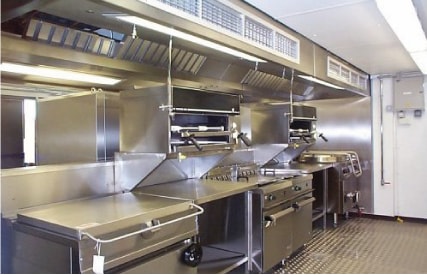
Standard commercial exhaust vent hood systems are the most common solution in professional kitchens. These systems are considered the backbone of many commercial exhaust hood installations because they are designed for consistent airflow, grease capture, and dependable performance.
Best suited for:
- Full-service restaurants.
- High-volume cooking environments.
- Kitchens producing grease, smoke, heat, and cooking vapors.
Key features:
- Durable stainless steel construction.
- Designed for consistent airflow and grease capture.
- Compatible with ducted ventilation systems.
- Require routine cleaning, filter maintenance, and proper system upkeep.
Ventless Commercial Kitchen Hoods
A commercial recirculating cooker hood, more commonly known as a ventless hood, is ideal when traditional ductwork is not possible. Instead of exhausting air outdoors, ventless commercial kitchen hood systems use internal filtration to clean and recirculate air.
Best suited for:
- Food courts and kiosks.
- Spaces without roof or wall access for ductwork.
- Smaller kitchens using approved electric cooking equipment.
- Locations where external ventilation is limited or impractical.
How they work:
- Use multi-stage filtration to clean air internally.
- Trap grease, smoke, and odors before recirculating air back into the space.
- Eliminate the need for traditional external ducting.
Key considerations:
- Require regular filter maintenance.
- Must be matched carefully to the cooking equipment being used.
- May not be suitable for heavy grease or high-heat cooking applications.
Exhaust-Only Hoods
Exhaust-only hoods are among the simplest exhaust hood types. These systems remove air from the space but do not include the grease filtration features found in Type 1 commercial exhaust hood systems.
Best suited for:
- Non-grease applications.
- Light-duty ventilation needs.
- Areas where contaminants are minimal.
Key features:
- Use fans to remove air from the space.
- Do not include grease filters.
- Typically used in light-duty applications.
While cost-effective, exhaust-only systems are not appropriate for grease-producing equipment. Using the wrong hood can create safety concerns and lead to failed inspections.
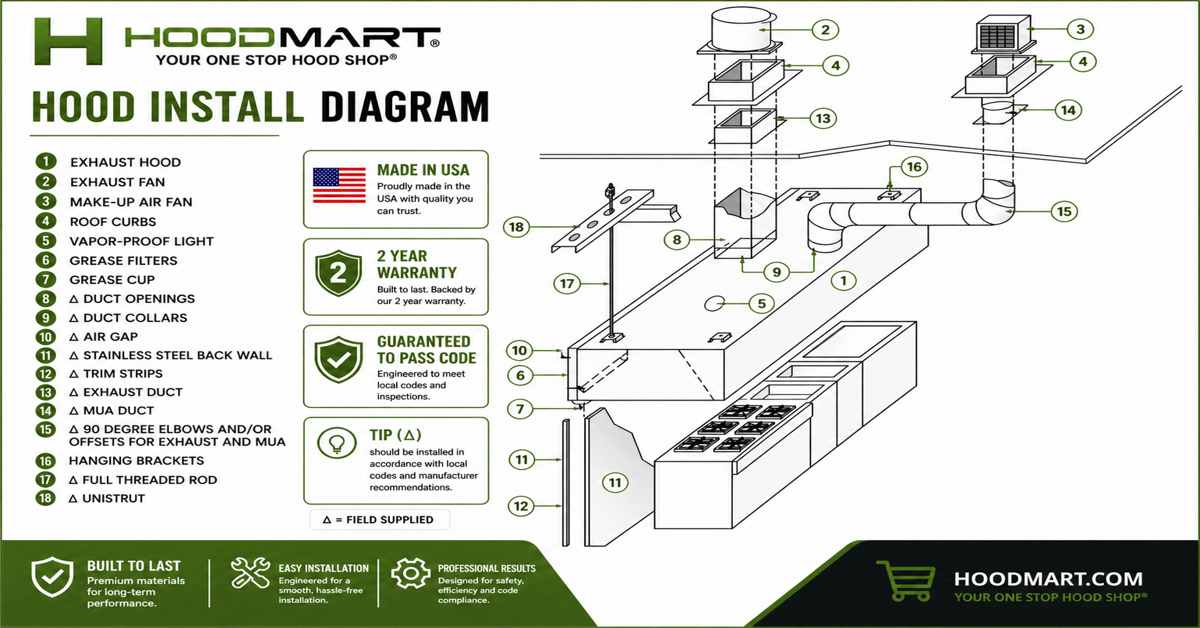
Choosing the Right Commercial Exhaust Hood
Selecting the right commercial exhaust hood depends on several factors. Before choosing a system, consider the type of cooking equipment being used, the amount of grease and smoke produced, the kitchen layout, and local building and fire codes.
Important factors include:
- Type of cooking equipment.
- Volume of grease, smoke, heat, and steam produced.
- Kitchen size and layout.
- Local building, fire, and ventilation codes.
- Availability of ductwork and proper ventilation pathways.
Choosing incorrectly can lead to:
- Failed inspections.
- Poor air quality.
- Increased fire risk.
- Costly retrofits or system replacements.
Partner With HoodMart for the Right Exhaust Hood System
Choosing between different types of commercial exhaust hoods can feel overwhelming, but it doesn’t have to be. HoodMart makes it easy to find the right solution, whether you need a Type 1 hood for grease-heavy cooking, a Type 2 hood for heat and steam, or a ventless commercial kitchen hood for a duct-free setup.
HoodMart offers:
- High-quality commercial exhaust hood systems.
- Ventless and recirculating hood options.
- Fire suppression system compatibility.
- Filters, ductwork, fans, and ventilation accessories.
- Expert guidance for choosing the right hood system for your kitchen.
If you’re planning a new kitchen or upgrading your current system, our experts are here to help you choose the right hood with confidence. Get a custom kitchen hood quote today to get started with HoodMart.
Frequently Asked Questions About Commercial Kitchen Ventilation Systems
What are the different types of commercial exhaust hoods?
The main types of commercial exhaust hoods include Type 1 hoods for grease-producing equipment, Type 2 hoods for heat and steam, ventless hoods, and exhaust-only systems.
What is the difference between Type 1 and Type 2 hoods?
The key difference in Type 1 vs Type 2 hood systems is that Type 1 hoods handle grease-laden vapors, while Type 2 hoods are designed for heat, steam, and non-grease applications.
What is a ventless commercial kitchen hood?
A ventless commercial kitchen hood uses internal filters to clean and recirculate air instead of venting it outside. This makes ventless hoods useful for spaces where traditional ductwork is not practical.
How do I know which commercial exhaust hood my kitchen needs?
The right hood depends on your cooking equipment, grease output, kitchen layout, available ductwork, and local code requirements. When in doubt, it’s best to work with a commercial kitchen ventilation expert before purchasing a system.

 CUSTOM FABRICATORRECEIVE INSTANT QUOTE
Loading Fabricator...
PROJECT ID : T626PROJECT NAME :
Already have a project?
Login 0
0
WELCOME
START YOUR PROJECT »
1-2 WEEKS!
CHOOSE CATEGORY
Worktables
Shelving
Counters & Cabinets


WELCOME TO OUR SHOP
PROJECT DETAILS
MANAGE PROJECTS
Save your current project, or modify your previous projects
CURRENT PROJECT
PROJECT NAME :
PREVIOUS PROJECTS
No Projects found.
Thank you for
creating your project with
North American Kitchen Solutions!
Account Login
Have a design in mind? Contact Us for a Free Consult


Blog Home




Dont see your size or need a custom hood?
Let Us Help You!
Talk to a Specialist
Call Now: 1.800.715.1014