

How a Commercial Kitchen Exhaust System Actually Works: From Hood to Rooftop
- Octubre 02, 2026
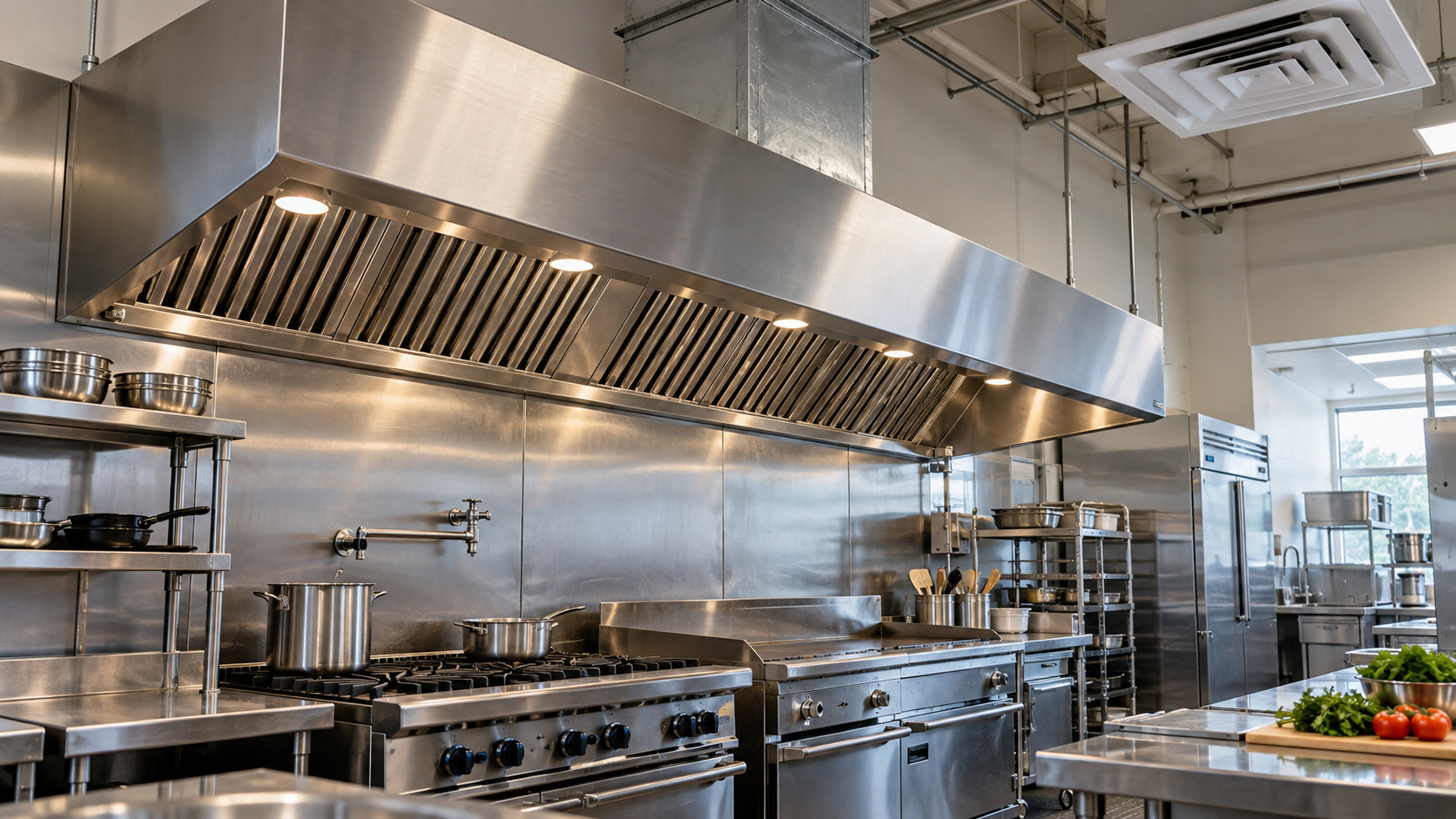
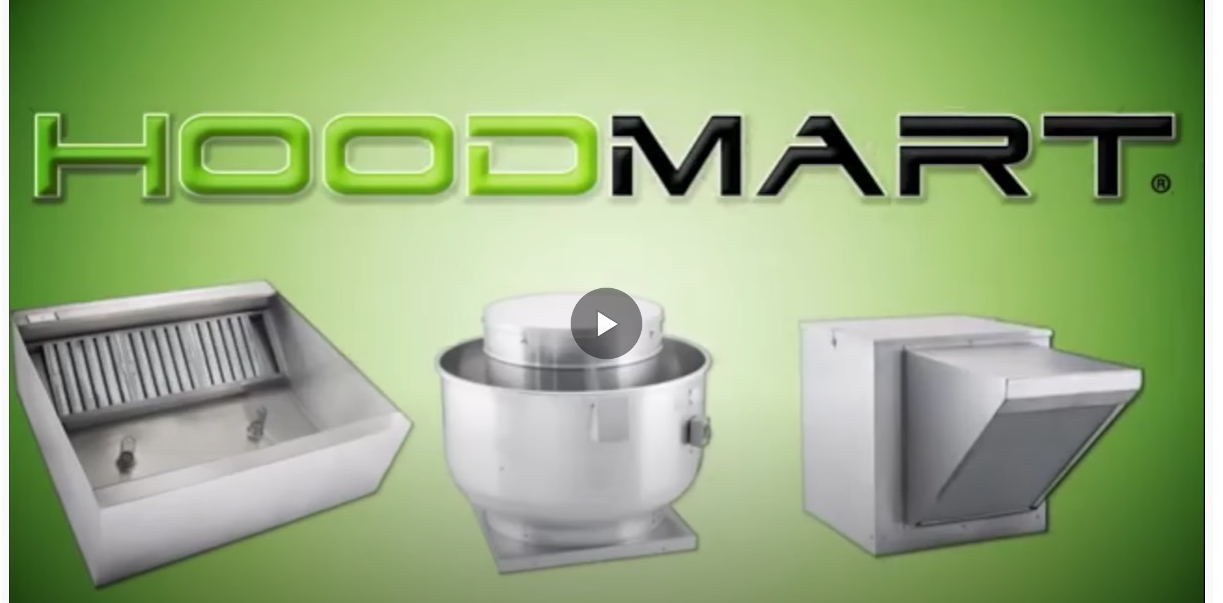
A commercial kitchen exhaust system is one of those things that gets specified, installed, and then largely ignored until something goes wrong. Which is fine, honestly - that’s exactly what a well-designed system should allow. But understanding how the full system works, from the moment heat and smoke rise off the cooking surface to the moment exhausted air exits the building, makes you a better-informed owner when it comes to maintenance, troubleshooting, and any future modifications. Here is the full picture, from the experts at HoodMart.
It Starts at the Cooking Surface
The exhaust process begins the moment cooking equipment generates heat, smoke, grease-laden vapor, or combustion byproducts. Those elements rise from the cooking surface in a thermal plume, a column of rising air carrying everything the cooking process produces.
- The plume rises and spreads as it moves upward, which is why hood overhang beyond the equipment footprint is required
- The hood is positioned directly above the cooking equipment to intercept the plume before it disperses into the kitchen
- Grease filters inside the hood capture grease particles from the airstream as it enters the hood cavity
Everything upstream of the hood is physics. Everything downstream is engineered to manage what the hood captures.
Inside the Hood
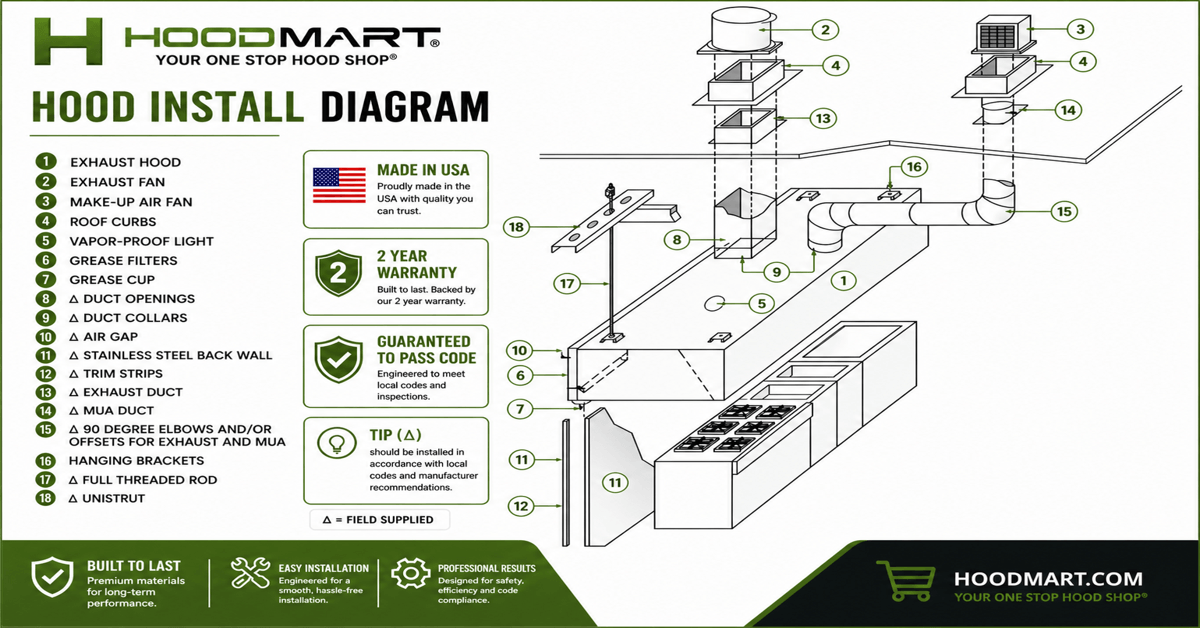
Once the thermal plume enters the hood, the exhaust system takes over. The hood is not a passive enclosure; it is an active capture device designed to direct contaminated air into the duct system efficiently.
- Grease filters slow the airstream and cause grease particles to coalesce and drain into the grease cup below
- The filtered air continues through the hood cavity toward the duct collar at the top or rear of the hood
- The duct collar is the transition point between the hood and the grease duct system that carries exhaust air through the building
Grease that does not drain into the cup accumulates on the hood interior and filter surfaces, which is why documented cleaning schedules under NFPA 96 are a code requirement and not just a housekeeping preference.
Through the Duct System
From the hood collar, exhaust air moves through the grease duct - a dedicated, continuous steel pathway that carries contaminated air from the hood to the exhaust fan at the rooftop.
- Grease duct must be constructed to NFPA 96 standards, with liquid-tight seams and no openings between the hood and the exterior termination
- The duct run must maintain required clearances to combustible building materials throughout its path through the building
- Access panels are required at intervals along the duct run to allow for inspection and cleaning
- Elbows and offsets navigate the duct around structural elements, but each directional change adds resistance to airflow that the exhaust fan must overcome
The duct system is where most installation complexity lives, particularly in existing buildings where the most direct path to the rooftop is rarely unobstructed.
The Exhaust Fan
The exhaust fan is the mechanical heart of the system. It is what creates the negative pressure inside the duct that pulls air through the hood and out of the building.
- Exhaust fans for commercial kitchen applications are typically upblast centrifugal fans mounted on the rooftop
- The fan must be sized to the CFM requirement of the hood, which is calculated based on cooking equipment type, duty level, and hood dimensions
- The fan mounts on a roof curb at the duct termination point, providing a weather-tight seal at the rooftop penetration
- Fan performance degrades with grease accumulation, which is why fan cleaning is part of the same NFPA 96 maintenance schedule as the hood and duct
An undersized or poorly maintained exhaust fan is one of the most common reasons a correctly specified hood underperforms in the field.
Makeup Air Completes the System
Exhaust alone is only half the equation. Every cubic foot of air the exhaust fan pulls out of the kitchen has to be replaced, or the kitchen operates under negative pressure with all the problems that creates.
- Makeup air is supplied through a dedicated makeup air unit, typically also rooftop-mounted
- Tempered makeup air units heat or cool the supply air before it enters the kitchen, depending on climate and jurisdiction requirements
- Makeup air is introduced into the kitchen either directly through the hood, through ceiling diffusers, or through a combination of both
- The makeup air volume is typically sized to replace 80 to 90 percent of the exhaust volume, with the remainder supplied through transfer air from adjacent spaces
Exhaust and makeup air work as a matched pair. A system that is well-balanced between the two performs predictably and efficiently. One that is out of balance creates negative pressure, comfort problems, and capture performance issues that are difficult to diagnose without understanding the full system.
Understanding Your System Makes You a Better Operator
Knowing how the full exhaust system works means you can recognize when something is off, ask better questions when a contractor is on site, and make more informed decisions about maintenance and modifications. HoodMart supplies complete commercial kitchen ventilation systems, from the hood itself through fans, makeup air units, and roof curbs. Request a commercial hood quote today!

 CUSTOM FABRICATORRECEIVE INSTANT QUOTE
Loading Fabricator...
PROJECT ID : T626PROJECT NAME :
Already have a project?
Login 0
0
WELCOME
START YOUR PROJECT »
1-2 WEEKS!
CHOOSE CATEGORY
Worktables
Shelving
Counters & Cabinets

WELCOME TO OUR SHOP
PROJECT DETAILS
MANAGE PROJECTS
Save your current project, or modify your previous projects
CURRENT PROJECT
PROJECT NAME :
PREVIOUS PROJECTS
No Projects found.
Thank you for
creating your project with
North American Kitchen Solutions!
Account Login
Have a design in mind? Contact Us for a Free Consult


Blog Home




Dont see your size or need a custom hood?
Let Us Help You!
Talk to a Specialist
Call Now: 1.800.715.1014