

Why Your Commercial Kitchen Hood Is Failing a Health Inspection (And You Don't Know It Yet)
- August 24, 2026

Health inspectors are not trying to surprise you. The violations they cite most often on commercial kitchen ventilation systems are the same ones, kitchen after kitchen, year after year. They are predictable, preventable, and almost always traceable to either a flawed installation or a neglected maintenance routine.
This guide, from ventilation experts at HoodMart, is your key to understanding both.
The Most Common Commercial Kitchen Ventilation Violations
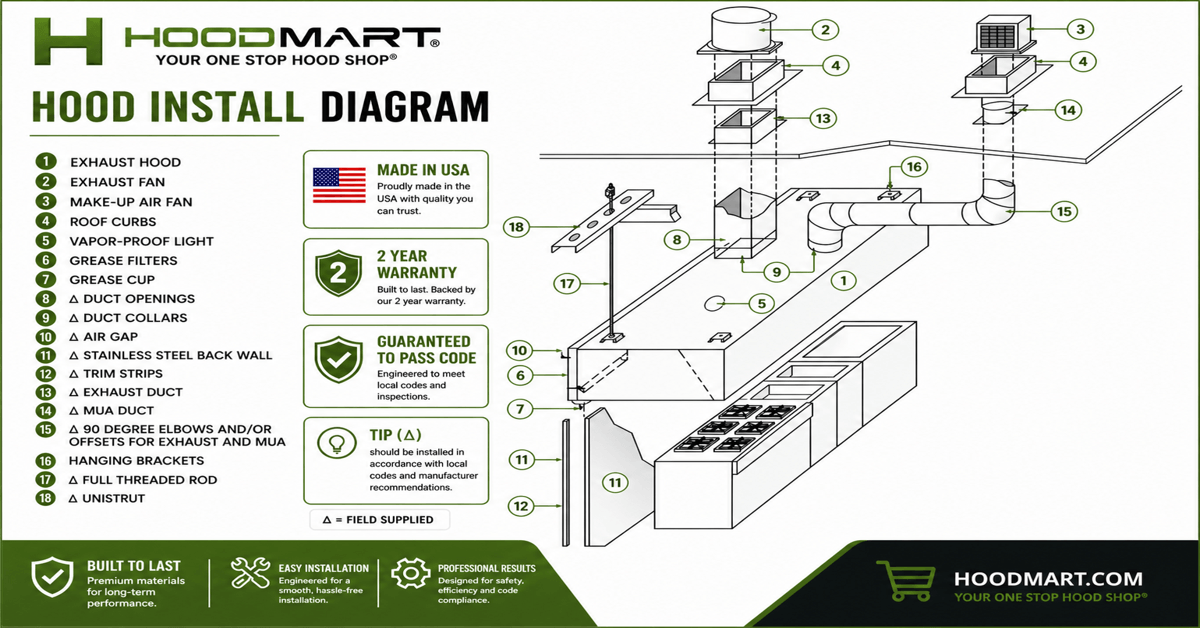
- Grease filter neglect tops nearly every list. Filters clogged with grease accumulation restrict airflow, reduce capture velocity, and create a fire hazard that inspectors are trained to identify on sight. In high-volume kitchens, filters require cleaning every 24 to 48 hours of cook time. This is not a suggestion; in most jurisdictions, it is a code requirement.
- A missing or full grease cup is the citation that embarrasses operators most, because it is so easily avoided. The grease cup exists to collect drippings from the filters above. When it overflows or disappears entirely, grease migrates onto surfaces it has no business touching.
- Improper hood-to-equipment alignment is an installation problem that shows up as an inspection problem. A hood that does not extend the required distance beyond the cooking surface cannot capture the full effluent plume. No amount of cleaning fixes an undersized or mispositioned hood.
- Duct and collar issues, including unsealed joints, grease accumulation inside the duct, and inadequate clearances from combustible construction, are among the more serious citations an inspector can issue. These point directly to installation quality and are expensive to correct after the fact.
- An unbalanced ventilation system reveals itself through symptoms rather than direct citation: back-drafting, doors that won't stay closed, pilot lights that extinguish unexpectedly. Savvy inspectors recognize these as signs of a make-up air problem, even when the hood itself looks clean.
Type 1 vs. Type 2 Hood: Why Misclassification Is a Compliance Risk
Misclassifying cooking equipment is more common than it should be. A Type 1 commercial hood is required over any equipment that produces grease-laden vapors, including fryers, griddles, char-broilers, and woks. Type 2 hoods handle heat and moisture only, and they do not meet the fire safety requirements for grease-producing equipment.
Installing a Type 2 hood over a Type 1 application is a code violation with real fire safety consequences. It will fail inspection, and correcting it mid-build is significantly more disruptive than specifying correctly from the start.
Who Installs Commercial Kitchen Hoods, and Why It Matters
Commercial hood installation is not a general contractor job. A complete system involves licensed HVAC or sheet metal contractors for ductwork, a roofer for curb flashing and waterproofing, an electrician for fan and lighting connections, and often a mechanical engineer for CFM calculations on larger systems.
The quality of that installation determines how your kitchen performs and whether it passes inspection, not just on opening day but every inspection that follows. A properly installed HoodMart system is engineered to pass local code requirements out of the box. What happens during field installation is equally important.
Pro Tip: Looking for a qualified installer to ensure your system is up to code? Utilize the HoodMart Installer directory to find a professional near you!
Frequently Asked Questions About Commercial Hood Inspections
Why is my commercial kitchen hood failing inspection even though it looks clean?
Visual cleanliness and code compliance are not the same thing. Common non-visible issues include grease accumulation inside the duct, improper clearances from combustible materials, and an unbalanced make-up air system. A clean hood face does not guarantee a clean bill of health.
How often should commercial kitchen hoods be professionally cleaned?
NFPA 96 recommends cleaning frequency based on cooking volume: monthly for high-volume or solid-fuel cooking, quarterly for moderate use, and annually for low-volume operations like churches or seasonal businesses. Local codes may require more frequent service.
What is the difference between a Type 1 and Type 2 commercial hood for inspection purposes?
Type 1 hoods are held to significantly higher standards, including fire-rated ductwork, grease-tight construction, and specific clearance requirements. Inspectors verify compliance with NFPA 96 for Type 1 installations. Type 2 systems face less stringent requirements but must still be appropriate for the equipment they serve.
Can I install a commercial kitchen hood myself?
The hood itself may be owner-installed in some jurisdictions, but the ductwork, electrical connections, and rooftop components typically require licensed contractors. Always verify requirements with your local Authority Having Jurisdiction before starting any commercial hood installation.
How do I know if my make-up air system is causing inspection problems?
Symptoms include doors that are difficult to open, pilot lights that extinguish during operation, and visible smoke migration beyond the hood capture zone. An HVAC contractor can measure supply and exhaust CFM to confirm whether your system is properly balanced.
Stay Ahead of Inspections With a System Built to Last
The best inspection strategy is a correctly specified, properly installed ventilation system that requires nothing more than consistent maintenance to stay compliant. HoodMart's commercial kitchen hoods are built in the USA, backed by a two-year warranty, and engineered to meet local code requirements from day one. Ready to build your system the right way? Request a commercial kitchen quote and talk to a ventilation specialist today.

 CUSTOM FABRICATORRECEIVE INSTANT QUOTE
Loading Fabricator...
PROJECT ID : T626PROJECT NAME :
Already have a project?
Login 0
0
WELCOME
START YOUR PROJECT »
1-2 WEEKS!
CHOOSE CATEGORY

Worktables
Shelving
Counters & Cabinets


WELCOME TO OUR SHOP
PROJECT DETAILS
MANAGE PROJECTS
Save your current project, or modify your previous projects
CURRENT PROJECT
PROJECT NAME :
PREVIOUS PROJECTS
No Projects found.
Thank you for
creating your project with
North American Kitchen Solutions!
Account Login
Have a design in mind? Contact Us for a Free Consult


Blog Home




Dont see your size or need a custom hood?
Let Us Help You!
Talk to a Specialist
Call Now: 1.800.715.1014