

How a Hanging Ventless Hood Works Without Ductwork or a Roof Fan
- September 14, 2026
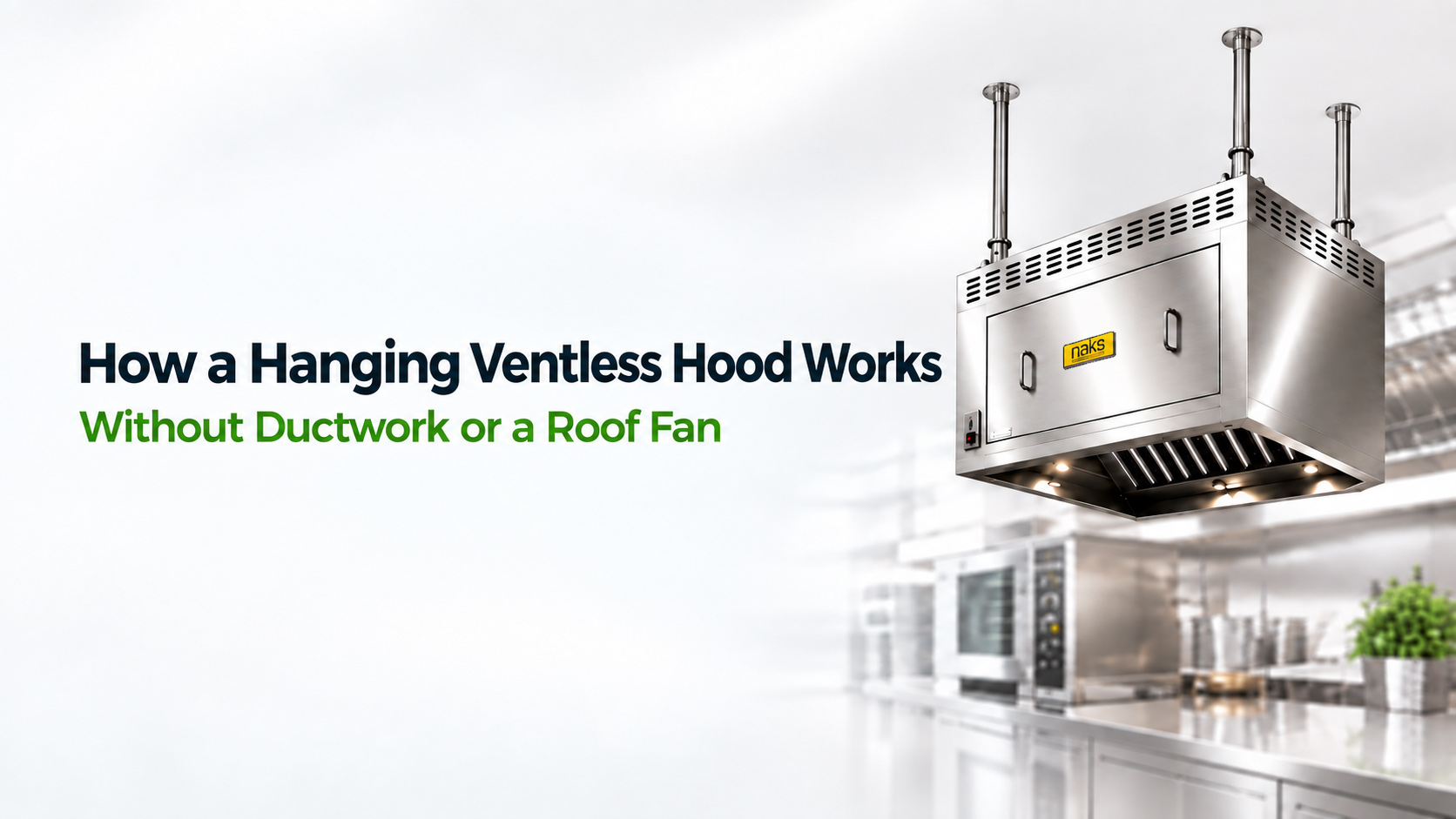
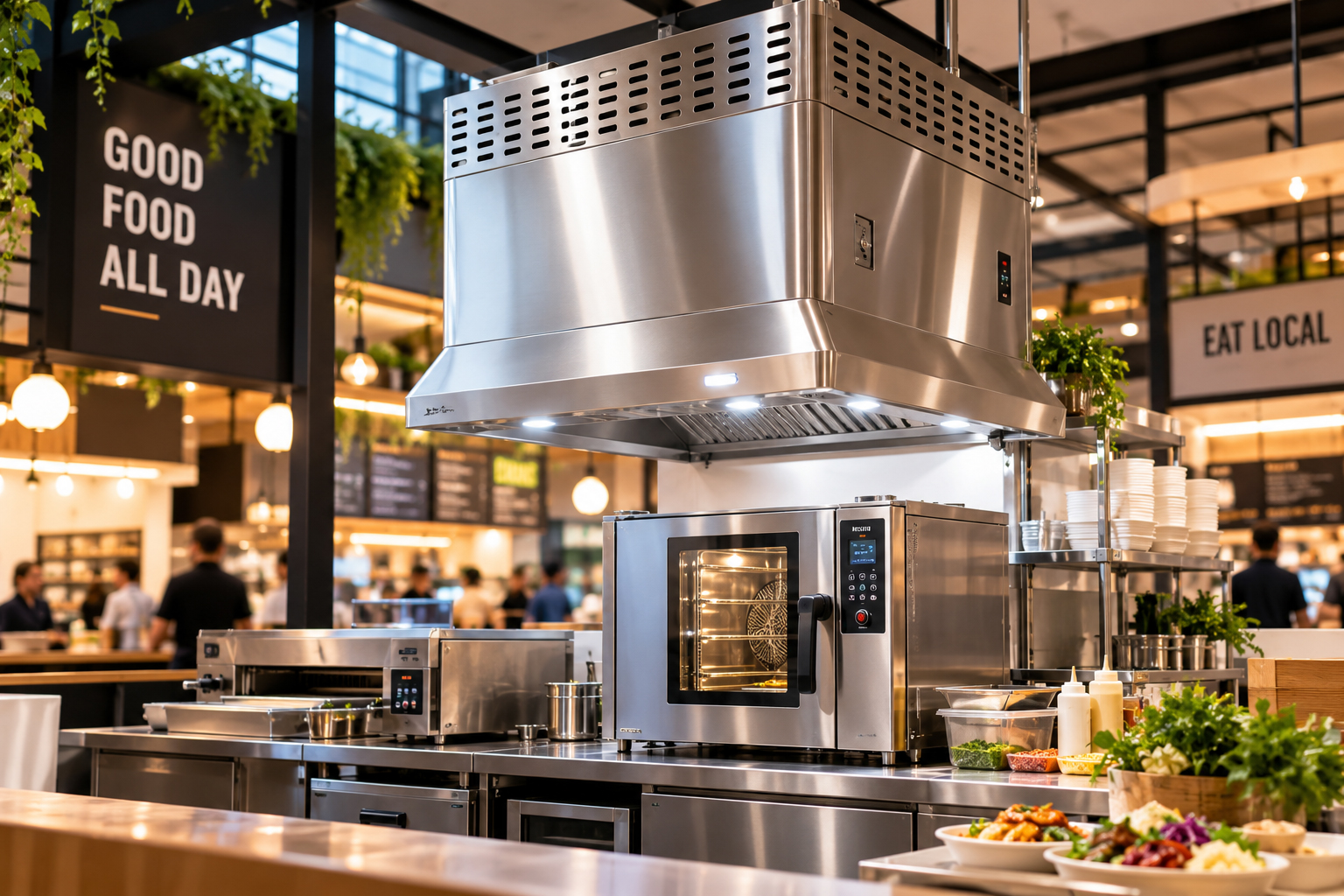
If a contractor has told you that venting your kitchen is impossible without cutting into the roof, they were working with the wrong hood. A hanging ventless hood handles grease-laden vapors, smoke, and odor capture on its own, no ductwork, no roof fan, no structural sign-off required.
This guide, from the commercial kitchen ventilation experts at HoodMart, takes a closer look at how these ventless kitchen hoods actually work.
No Ductwork = No Roof Penetration
A traditional exhaust hood pulls air through ducts and out through the roof. A hanging ventless hood skips that step entirely. It filters and recirculates air right where it's captured, so there's nothing to run through the ceiling and nothing for a roofing contractor to sign off on.
That matters most when:
- You're in a leased space where roof access isn't allowed
- You're on an upper floor with no direct path to the roof
- Your building has historic or structural restrictions on penetrations
- You need to install fast and can't wait on permits for roof work
UL 710B: the certification that makes it code-legal
"Ventless" alone isn't a code term, and any inspector will tell you that. What actually matters is UL 710B, the listing that governs recirculating Type I hood systems for grease-producing equipment. A hood that carries this listing has been tested for grease capture, filtration, and fire protection as a complete system, not just as individual parts.
HoodMart's hanging ventless hoods are UL 710B Listed and built to meet NFPA 96 requirements, so inspectors are looking at a system they already recognize.
What's Doing The Work Inside The Hood
Instead of ductwork moving smoke outside, three things happen inside the hood itself:
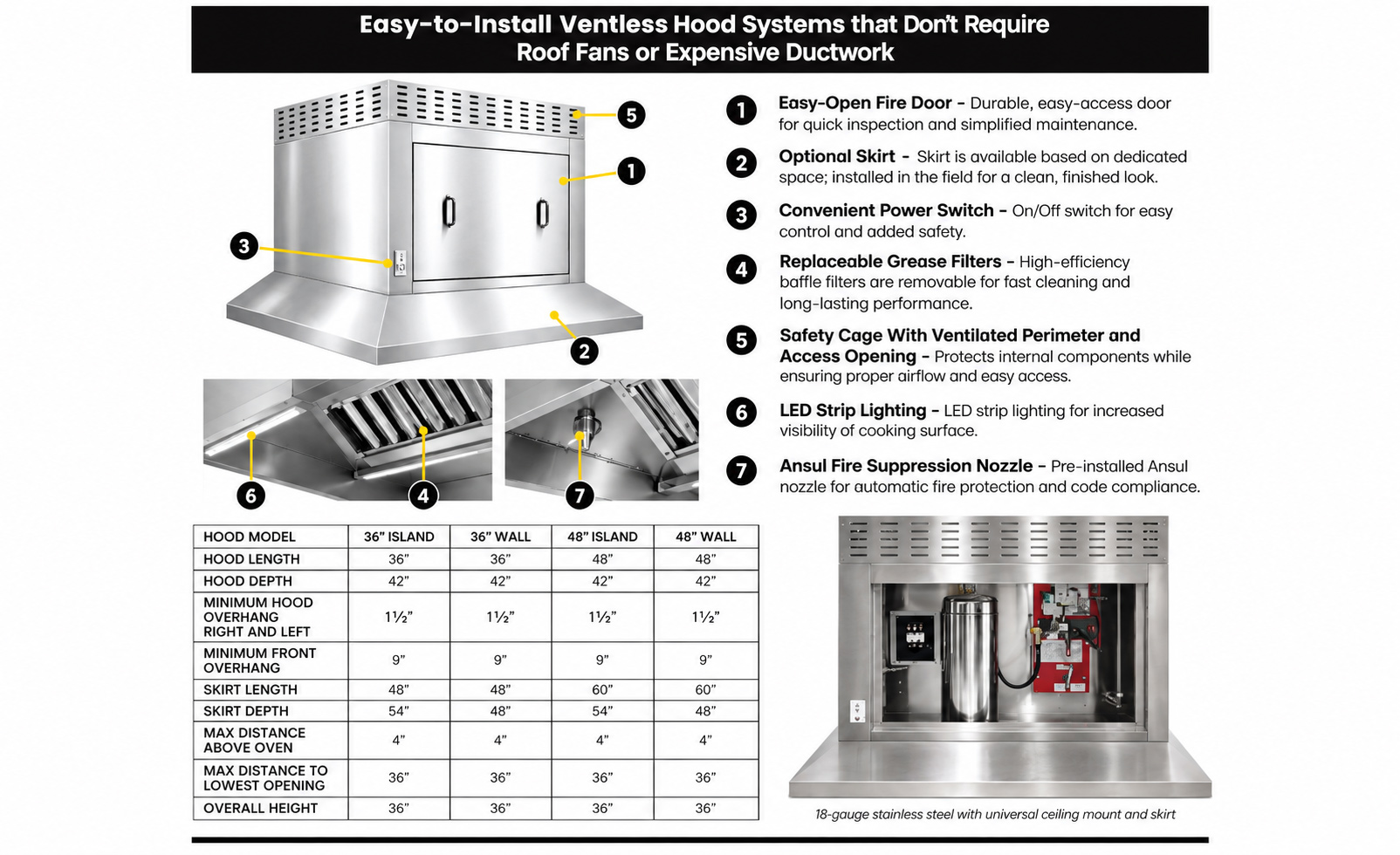
- Triple filter technology pulls grease and airborne particles through a stainless filter, an aluminum mesh stage, and a carbon filter before air is released back into the kitchen
- Integrated fire suppression is pre-installed and wired to the hood, so there's no separate suppression install to coordinate
- Equipment interlock keeps the hood and the oven from operating out of sequence, which is the kind of detail inspectors check first
Equipment Fit, Cost Savings, and Sizing for a Hanging Ventless Hood
A hanging ventless hood is built specifically for electric cooking equipment, convection ovens, conveyor ovens, combination ovens, deck ovens, rotisseries, and popcorn machines, all rated up to 550°F. It is not a fit for open-flame or gas equipment producing heavier grease loads.
That equipment fit is also where the savings show up. Every roof penetration comes with its own line items: structural engineering review, roofing contractor fees, HVAC rebalancing, and the permit delays that stack on top of all of it. Because a hanging ventless hood skips the roof entirely, it removes those costs from the estimate before they ever appear.
- Available in 36" and 48" sizes
- Wall-mount and island configurations
- Built for retrofits, upper floors, and any layout where roof work isn't an option
- Sized for speed and flexibility over a traditional exhaust run
For kitchens that can't get to the roof, or don't want to pay to, a hanging ventless hood delivers the same code-compliant protection without the construction timeline attached to it.
Ready to see which configuration fits your kitchen? Request a quote today to talk through your layout with our team.
Ventless Commercial Kitchen Hood FAQs
Q: Does a ventless hood still need a fire suppression system?
A: Yes. HoodMart's hanging ventless hoods come with fire suppression built in and pre-installed, so it's part of the unit rather than a separate system to install and coordinate.
Q: Can a ventless hood be used with gas equipment?
A: No. These systems are designed and rated for electric cooking equipment only, up to 550°F.
Q: Will an inspector approve a hanging ventless hood?
A: Yes, when it carries a UL 710B listing and meets NFPA 96 requirements, which HoodMart's hanging ventless hoods do.

 CUSTOM FABRICATORRECEIVE INSTANT QUOTE
Loading Fabricator...
PROJECT ID : T626PROJECT NAME :
Already have a project?
Login 0
0
WELCOME
START YOUR PROJECT »
1-2 WEEKS!
CHOOSE CATEGORY
Worktables
Shelving
Counters & Cabinets


WELCOME TO OUR SHOP
PROJECT DETAILS
MANAGE PROJECTS
Save your current project, or modify your previous projects
CURRENT PROJECT
PROJECT NAME :
PREVIOUS PROJECTS
No Projects found.
Thank you for
creating your project with
North American Kitchen Solutions!
Account Login
Have a design in mind? Contact Us for a Free Consult
Blog Home




Dont see your size or need a custom hood?
Let Us Help You!
Talk to a Specialist
Call Now: 1.800.715.1014